Applied Behavior Analysis for Children with Autism Spectrum Disorder | Next Level Speech and Physiotherapy Center, Dubai
The diagnosis arrives, and then comes the quiet that follows it. Parents sit with a word — autism — and try to figure out what it means for their child, for their family, for the years ahead. Some find the diagnosis a relief after months of wondering. Others feel the ground shift beneath them. Most feel both at once.
What tends to cut through that uncertainty is having somewhere concrete to go next. ABA therapy is, for many children with autism spectrum disorder, that next step. At Next Level Speech and Physiotherapy Center, Dubai, our ABA program for children with autism is built around one straightforward idea: every child can learn, and the right environment and approach makes that learning possible.
What ABA Therapy Does for Children with Autism
Autism affects how children communicate, connect, and process the world around them. No two children present the same way. One child may be largely non-verbal and struggle with basic daily routines. Another may speak fluently but find social situations deeply confusing. ABA therapy works across that entire range.
The approach identifies the specific skills a child needs to build and the behaviors that are getting in the way of their learning or daily life. It then uses structured, positive, data-driven methods to develop those skills systematically. Goals are not generic — they are chosen because they matter to that child’s actual life.
For children with autism, this typically means working on communication, social interaction, play skills, self-care routines, and behavioral regulation. The balance depends entirely on the child.
Signs ABA Therapy May Be the Right Fit
Parents often arrive at our clinic having already noticed a pattern — behaviors that repeat, communication that stalls, responses to the environment that feel disproportionate. Some have a diagnosis. Some are still waiting for one.
The following are signs that an ABA assessment is worth pursuing:
- Your child does not respond consistently to their name or to simple verbal instructions
- Communication is limited — whether that means no words yet, single words only, or speech that does not seem to connect meaningfully with others
- Play tends to be solitary, repetitive, or focused on objects in unusual ways
- Transitions between activities, places, or people cause significant distress
- Certain routines or sensory experiences trigger intense reactions that are hard to de-escalate
- Social interaction feels effortful or absent — your child does not seek connection with other children or adults in the way you might expect
A formal autism diagnosis is not required to begin. If your child is showing several of these signs and you are looking for structured support, our team can assess them and advise on whether ABA is appropriate at this stage.
How We Assess Children with Autism
The assessment process at Next Level Speech and Physiotherapy Center, Dubai is thorough and unhurried. Our therapist spends time observing your child directly — watching how they play, how they respond to their environment, and how they interact with the people around them.
Alongside that observation, we gather detailed information from you. Parents know things about their child that no assessment tool can capture, and that knowledge shapes the program we build.
From the assessment, we identify priority skill areas and the specific behaviors or barriers that need to be addressed first. The findings are explained clearly, and you will have the opportunity to ask questions before any therapy begins.
The Therapy Itself
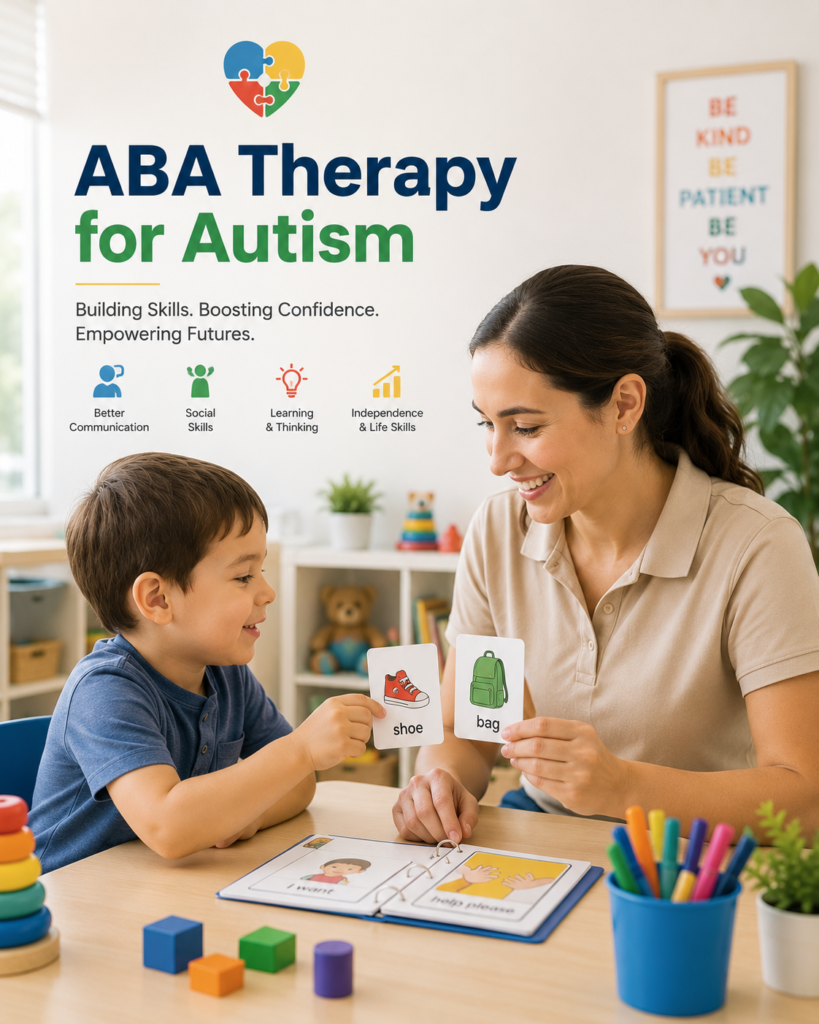
Sessions at our JBR clinic are play-based, warm, and purposeful. For young children especially, therapy does not look clinical — it looks like play, because play is how young children learn best. Our therapists follow the child’s interests, embed learning opportunities naturally into activities, and use positive reinforcement that is genuinely motivating for that individual child.
The methods we draw on include Discrete Trial Training, Natural Environment Teaching, and Pivotal Response Treatment. The combination depends on the child’s age, profile, and goals. For a pre-verbal four-year-old working toward functional communication, the approach will look different from a seven-year-old working on peer interaction and classroom readiness.
Progress is tracked in every session. Data is reviewed regularly and goals are updated as the child develops. This is not a program that stays fixed while the child changes — it moves with them.
Building Skills That Transfer Beyond the Clinic
One of the things parents ask most often is whether gains made in therapy actually show up at home, at school, and in the community. The honest answer is that they do — but only when the people around the child are working in a consistent direction.
That is why family involvement is built into our ABA program from the start. We share the strategies we use in sessions, explain the reasoning behind them, and help parents apply them in everyday moments — the morning routine in your apartment in Dubai Marina, the trip to the supermarket, the school pickup. When the approach is consistent across settings, children generalize their skills far more reliably.
Parent training sessions are also available separately for families who want a deeper grounding in ABA principles.
What Progress Looks Like Over Time
Progress in ABA therapy for autism is rarely linear, and it is always individual. Some children make rapid gains in communication in the early months and the change is visible almost immediately. Others build steadily across a longer period, with progress that becomes clear when you look back at where they started rather than forward at where you hoped they would be.
Families from across Dubai Marina, JLT, Palm Jumeirah, and Bluewaters have told us that the moments that mean the most are often small ones. A child who now asks for what they want instead of melting down. A child who tolerates a haircut. A child who plays alongside another child for the first time. These are the outcomes that change the texture of daily family life, and they are what our program is working toward.
Why Next Level Speech and Physiotherapy Center, Dubai
Our ABA therapists are DHA-licensed and trained specifically in behavioral intervention for children with autism. The clinic is multidisciplinary — speech therapy and occupational therapy are available in the same building, and programs can be coordinated when a child needs support across more than one area. Many children with autism benefit from a combination of ABA and speech therapy, and having both under one roof makes that coordination practical rather than complicated.
The clinic is located in JBR, easily reached from across the Marina, JLT, The Greens, and surrounding communities. Flexible scheduling is available for working families.
Book an ABA Assessment for Your Child
If your child has received an autism diagnosis — or if you are seeing signs that concern you and want an informed opinion — the first step is an assessment. It gives you a clear picture of where your child is, what they need, and what a realistic program of support looks like.
Reach our team through our contact page to book an assessment or ask anything you need answered first. You can also message us directly on WhatsApp for a quicker response. Our full ABA therapy service information is available on our ABA therapy page.
We see families from Dubai Marina, JBR, JLT, Palm Jumeirah, Bluewaters, The Greens, and across the wider Dubai area.
Frequently Asked Questions
My child was just diagnosed with autism. How soon should we start ABA therapy? As soon as you are ready, and ideally as soon as possible. The brain is most responsive to structured learning in the early years, and starting ABA therapy shortly after diagnosis gives children the best chance of making meaningful gains before they reach school age. That said, it is never too late — children diagnosed later still make real progress with a well-designed program.
What if my child is non-verbal? Can ABA still help? Yes, and it is one of the areas where ABA has the strongest evidence behind it. For pre-verbal children or those with very limited communication, the program focuses heavily on building functional communication — whether that means spoken words, picture-based systems, or augmentative and alternative communication (AAC) devices. Our team works closely with speech therapists where needed to support this.
How is ABA different from other autism therapies? ABA is a behavioral approach — it focuses on observable skills and behaviors, breaks them into teachable steps, and uses consistent reinforcement to build them systematically. Other therapies like speech therapy or occupational therapy target specific domains. ABA tends to be broader in scope and more data-driven in its tracking. Many children benefit from ABA alongside other therapies rather than instead of them.
Will my child just be doing drills and repetitive tasks? Modern ABA looks very different from the structured drill-based approaches of earlier decades. Most of what happens in sessions at our clinic is naturalistic and play-based, particularly for younger children. Learning targets are embedded into activities the child finds genuinely engaging. Repetition exists, but it is purposeful and woven into play rather than presented as rote exercises.
How long does an ABA program for autism typically last? There is no standard duration. Some children make rapid gains and reach their goals within a year. Others benefit from longer-term support as their needs evolve across different developmental stages. Your child’s therapist will set clear, measurable goals and review them regularly. The program continues as long as it is producing meaningful progress toward goals that matter.
What is the right number of therapy hours per week for a child with autism? It depends on the child’s age, severity of presentation, and goals. Research generally supports more intensive early intervention — some guidelines suggest 20 to 40 hours per week for young children with significant needs. In practice, many families cannot manage that intensity, and a well-designed program with fewer hours can still produce meaningful gains. Your therapist will recommend a realistic schedule based on the assessment and your family’s capacity.
Can ABA therapy help with meltdowns and difficult behaviors? Yes. Behavioral regulation is often a significant focus of ABA programs for children with autism. The approach involves understanding what is driving the behavior — what the child is communicating or responding to — and then building skills that serve the same function in a more appropriate way. This takes time, but it is one of the areas where families often notice the most significant changes in daily life.
Will therapy work on skills my child needs for school? School readiness is a common goal area in ABA programs for children approaching or already in their school years. This includes attending to instructions, sitting for short tasks, transitioning between activities, interacting with peers, and managing the sensory and social demands of a classroom environment. If your child’s school has specific concerns, sharing that information with the therapist helps ensure those goals are prioritized.
Do you work with children who have already had ABA therapy elsewhere? Yes. If your child has previously received ABA therapy, whether in Dubai or abroad, we can review their existing program and goals, complete a fresh assessment, and build a new program from where they currently are. Prior therapy history is useful context and will be factored into the assessment.
How do I know if the ABA program is working? Progress is tracked in data collected during every session, and your therapist will share updates with you regularly. Beyond the data, the clearest sign is observable change in your child’s daily life — skills that were absent or inconsistent becoming reliable, behaviors that were disruptive becoming manageable. If progress has stalled, the program is reviewed and adjusted. A good ABA program is never static.