
Equipping Families to Support Their Child’s Progress Every Day | Next Level Speech and Physiotherapy Center, Dubai
A parent sits through their child’s therapy session, watches the therapist work, and thinks: how does she get him to do that so calmly? The child who screams through haircuts at home sits still. The child who refuses to follow any instruction at home responds on the first ask. The parent drives home wondering what is happening in those sessions that is not happening everywhere else.
The answer is usually not magic. It is consistency, specific technique, and a clear understanding of why the child behaves the way they do. Parent training exists to put that understanding in the hands of the people who spend the most time with the child — because no therapist, however skilled, sees a child for more than a few hours a week. Parents and caregivers are with that child for everything else.
At Next Level Speech and Physiotherapy Center, Dubai, parent training and caregiver coaching is offered both as a standalone program and as an integrated component of our ABA therapy services. Either way, the goal is the same: families who understand the approach, can apply it confidently, and do not need to wait for the next therapy session to support their child’s progress.
Why Parent Training Matters
ABA therapy produces its strongest outcomes when the principles being used in sessions are also present in the child’s daily environment. A child who is learning to request items appropriately in clinic but is still getting what they want through screaming at home is receiving two contradictory messages. The progress made in therapy will be slower, and the skills learned will generalize less reliably.
This is not a criticism of parents. It is a structural reality of how learning works. Skills that are reinforced consistently across all settings consolidate faster and hold longer than skills that are only reinforced in one. When parents understand what the therapist is doing and why, and can replicate the key elements at home, the child effectively receives more therapy — not in formal sessions, but in the accumulated hours of daily life.
Research in ABA consistently shows that programs with strong parent involvement produce better outcomes than programs where therapy is delivered in isolation from the family. This is not a minor finding. It is one of the most reliable patterns in the literature.
What Parent Training Covers
The content of parent training at Next Level Speech and Physiotherapy Center, Dubai is not a fixed curriculum. It is shaped by what your child is working on, what your family’s daily challenges look like, and where you feel least confident in your ability to support your child effectively.
That said, most programs cover a core set of areas that tend to be most relevant across families:
Understanding behavior — what drives it, what maintains it, and what changes it. This means moving past “my child is being difficult” toward a functional understanding of why the behavior is happening and what it is communicating. A child who melts down every time the television is turned off is not being manipulative. They are struggling with transition. Understanding that reframes the problem and opens up different solutions.
Reinforcement — how to identify what genuinely motivates your child and use it effectively to build skills and encourage cooperation. Most parents use praise, but praise is not equally motivating for all children. Parent training helps families find what actually works for their specific child and use it deliberately rather than by chance.
Prompting and fading — how to provide the right level of support when teaching a skill without creating dependence on that support. The goal is always independence, and the path there involves giving exactly as much help as the child needs and systematically reducing it as their competence grows.
Managing difficult behavior — specific strategies for responding to meltdowns, refusal, aggression, and other challenging presentations in ways that reduce the behavior over time rather than accidentally reinforcing it. This section of parent training is often the one families find most immediately useful.
Generalization — how to help the child transfer skills learned in therapy to new settings, new people, and new situations. This includes how to structure practice opportunities at home, how to introduce skills in new contexts, and how to recognize when a skill has genuinely consolidated versus when it is still fragile.
Who This Program Is For
Parent training is relevant for any family with a child receiving ABA therapy. It is also relevant for families who are not yet in a formal ABA program but are managing significant behavioral or developmental challenges at home and want a structured framework for responding to them.
Caregivers beyond parents — grandparents, nannies, au pairs, and other regular caregivers — are welcome and encouraged to participate where relevant. A child whose primary daytime caregiver does not understand the approach being used in therapy will generalize skills more slowly than a child whose entire caregiving environment is pointed in the same direction.
School staff are not typically part of parent training sessions, but with parental consent our therapists can provide written guidance and strategies that parents can share with teachers and support staff to extend consistency into the school environment.
How Sessions Work
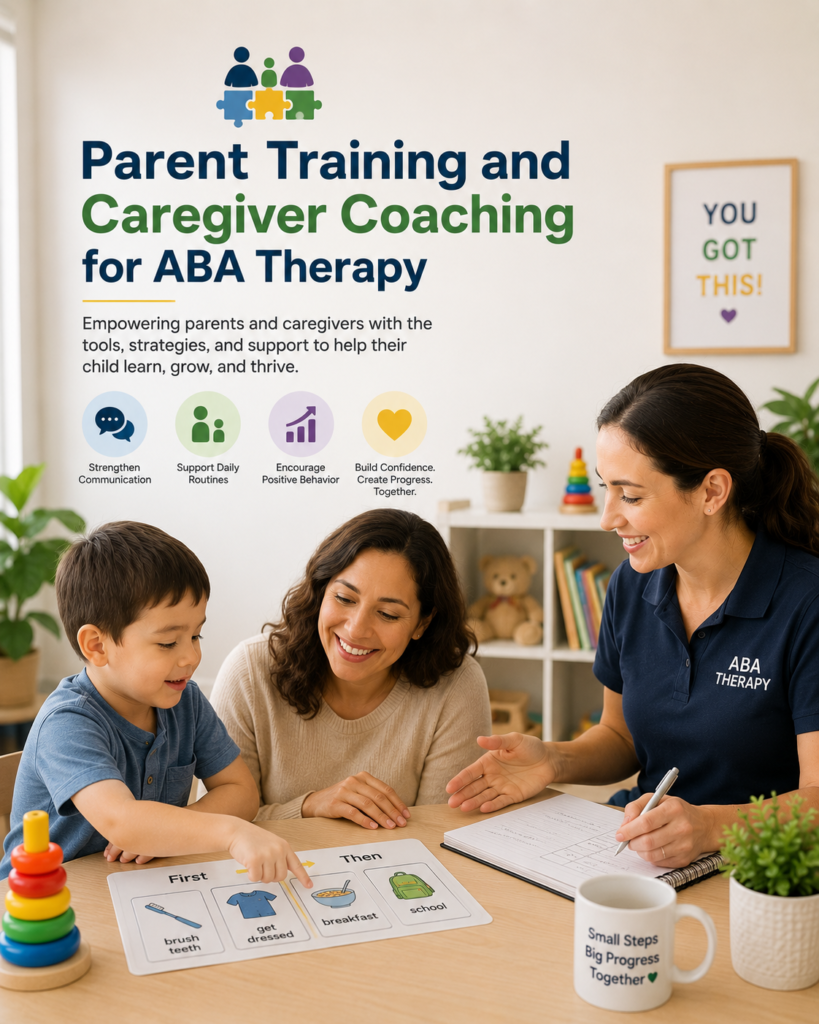
Parent training sessions at Next Level Speech and Physiotherapy Center, Dubai are structured conversations combined with direct observation and practice. They are not lectures. The goal is not for parents to sit and receive information — it is for parents to leave each session with something they can actually do differently the next time a difficult moment arises.
Sessions typically begin with a review of what has happened since the last meeting — what worked, what did not, what situations came up that the parent was unsure how to handle. This grounds the session in real life rather than theory.
From there, the therapist introduces or revisits specific strategies relevant to the child’s current goals and the family’s current challenges. Strategies are explained in plain language, demonstrated where possible, and then practiced — the parent tries the approach with the child while the therapist observes and provides feedback.
Between sessions, parents are encouraged to try the strategies in their daily routines and note what they observe. These observations become the starting point for the next session. The process is iterative and responsive — it adjusts to what is actually happening in the family’s life rather than following a fixed script.
Coaching in the Home Environment
For families who prefer it, or for whom the specific goals are most relevant in the home context, parent training can be delivered at home. A therapist visits, observes the family’s actual routines — mealtimes, transitions, morning and bedtime routines — and provides coaching within those contexts rather than in a clinic room.
This is often the most efficient model for families whose primary challenges are rooted in daily home routines. Coaching a parent through an actual mealtime, in real time, with their actual child, produces faster and more durable change than discussing what to do in the abstract.
Home-based coaching is available for families across Dubai Marina, JBR, JLT, Palm Jumeirah, Bluewaters, The Greens, and surrounding communities.
Common Challenges This Program Addresses
Parents come to caregiver coaching with a range of specific challenges. Some of the most common ones this program addresses directly:
Meltdowns and emotional dysregulation — understanding what triggers them, how to reduce their frequency, and how to respond in the moment in ways that support the child rather than escalate the situation.
Refusal and non-compliance — building cooperation through structure, routine, and reinforcement rather than through repeated instruction and escalating conflict.
Transitions — helping children move between activities, locations, and caregivers with less distress, using predictability, visual supports, and graduated practice.
Sleep and bedtime — establishing routines and responding to bedtime resistance in ways that build independent sleep over time.
Mealtime behavior — managing food refusal, restricted eating, and difficult behavior at the table in a way that reduces pressure while gradually expanding what the child will accept.
Sibling dynamics — navigating the complexity of a household where one child has significant needs alongside children who do not, and supporting healthy relationships between them.
What Progress Looks Like for Families
Parent training produces two kinds of change. The first is practical — specific behaviors become more manageable, specific routines run more smoothly, specific situations that were reliably difficult become less so. Families from across Dubai Marina, JLT, and Palm Jumeirah describe this as the point where daily life begins to feel sustainable rather than exhausting.
The second change is harder to measure but equally significant. Parents who understand why their child behaves the way they do, and who have a framework for responding, feel less helpless. The sense that every difficult moment is a crisis to be survived gives way to a sense that difficult moments are problems with solutions — problems that the family has the tools to work through.
That shift in confidence has its own downstream effects. Parents who feel capable tend to be calmer in difficult moments. Calmer parents produce calmer children. The therapeutic effect of a well-supported family extends well beyond any individual strategy.
Why Next Level Speech and Physiotherapy Center, Dubai
Our therapists are DHA-licensed and trained in ABA, with specific experience in parent-mediated intervention. Parent training is not an add-on to our ABA programs — it is a core component of how we work. Families are not passive recipients of therapy delivered to their child. They are active participants in a program that is designed to extend beyond the clinic and into every part of daily life.
Because our clinic is multidisciplinary, families whose children are receiving speech therapy or occupational therapy alongside ABA can receive coordinated parent guidance across all three services. The strategies and language used by each therapist are aligned so that families receive one consistent message rather than three separate sets of advice.
The clinic is located in JBR, accessible from across Dubai Marina, JLT, Bluewaters, and surrounding communities. Home-based coaching sessions are available for families across these areas.
Book a Parent Training Session
If you are already part of an ABA program at Next Level Speech and Physiotherapy Center, Dubai, speak to your therapist about incorporating parent training into your child’s program. If you are not yet in a program and want to begin with parent training, or if you are managing significant challenges at home and want a structured framework before committing to a full therapy program, reach out to our team directly.
Contact us through our contact page to book a session or ask any questions before getting started. You can also reach us directly on WhatsApp. Our full range of ABA programs is outlined on our ABA therapy page.
Frequently Asked Questions
Do I need to be enrolled in ABA therapy at your clinic to access parent training? No. Parent training and caregiver coaching is available as a standalone program for families who are managing behavioral or developmental challenges at home and want a structured framework, regardless of whether their child is currently receiving ABA therapy at our clinic. It is also available as an integrated component for families already in one of our ABA programs.
How many parent training sessions will we need? It depends on the complexity of what you are working on and how quickly strategies translate into change at home. Some families find that four to six sessions gives them enough foundation to continue independently. Others benefit from ongoing monthly sessions that evolve alongside their child’s development. Your therapist will give you an honest estimate after an initial consultation and review it as the program progresses.
Can my child’s nanny or grandparent attend sessions instead of me? Yes. Any adult who spends significant time caring for the child is welcome to participate, and in many families it makes sense for more than one caregiver to attend. Consistency across caregivers is one of the most important factors in how quickly a child generalizes skills and how durable behavioral change is. A strategy that only one caregiver in a household uses will have limited impact.
What if my partner and I disagree on how to handle our child’s behavior? This is one of the most common challenges families bring to parent training, and it is worth addressing directly rather than working around. Sessions can involve both parents, and the therapist can help facilitate a shared understanding of the approach and why consistency between caregivers matters. Disagreement about how to respond to a child’s behavior is normal. Having a framework that both parents understand and have bought into makes consistency much more achievable.
Will parent training tell me I have been doing everything wrong? No. Parent training is not about assigning blame or identifying what parents have been doing incorrectly. Most families managing a child with significant behavioral or developmental challenges are doing their best with the information and resources they have. The goal of parent training is to add to that — to provide a framework and specific strategies that make the approaches parents are already using more effective, and to introduce new ones where the current approach is not producing the results the family needs.
Can parent training help with a child who does not have a formal diagnosis? Yes. Parent training is appropriate whenever a family is managing behavioral or developmental challenges that are affecting daily life, regardless of whether a formal diagnosis is in place. The strategies taught in parent training are based on behavioral principles that apply across a wide range of presentations.
How is parent training different from just reading a book about ABA or watching videos online? Books and videos provide information. Parent training provides individualized application. A therapist who knows your child, your family’s specific challenges, and the precise situations that are most difficult can give you strategies tailored to your actual circumstances — and can observe you applying them, give feedback in real time, and adjust the approach based on what they see. That level of specificity is not available from general resources, however good they are.
What happens if I try a strategy and it does not work at home? This is expected and is exactly the kind of information that makes parent training useful. When a strategy does not produce the expected result at home, the therapist uses that information to understand why — whether the strategy needs to be applied differently, whether a different approach is needed, or whether something in the environment is interfering. Parent training sessions always begin with a review of what has happened since the last meeting precisely because real-world application produces real-world information that refines the program.
Can parent training help with sibling relationships in the family? Yes. Managing the dynamics of a household where one child has significant needs alongside siblings who do not is a common challenge that parent training can address directly. This includes how to give appropriate attention to all children, how to help siblings understand their brother’s or sister’s difficulties in age-appropriate terms, and how to manage situations where the sibling relationship itself becomes a source of behavioral difficulty.
Is parent training available in languages other than English? Our team’s multilingual background means that sessions can be conducted in languages other than English in many cases. Reach out to our team to confirm availability in a specific language before booking.