Speech Therapy
Speech and Language Therapy for Kids & Adults in Dubai
There is a particular kind of worry that settles in quietly. Maybe you have noticed your child is not saying as many words as other children their age. Maybe they get frustrated when you do not understand them, and you are not sure whether to wait it out or do something about it.
Or maybe you are an adult who has been managing a stutter for years. Or you are helping a family member find their words again after a stroke, and you do not know where to begin.
Whatever brought you here, you are in the right place.
At Next Level Speech and Physiotherapy Center, Dubai, we work with children and adults at every stage of communication. From a child saying their first words, to an adult rebuilding confidence in conversation, we are here for all of it.
Our team of DHA-licensed speech therapists is based in JBR, right in the heart of the Dubai Marina community. We see families from Dubai Marina, JLT, Bluewaters, Palm Jumeirah, The Greens, and further afield. Most of them come to us not because of a formal diagnosis, but because something feels worth looking into, and they want to do something about it.
Speech Therapy for Children
For children, communication shapes almost everything. How they make friends. How they cope in a classroom. How they let you know what they need or how they are feeling.
When something gets in the way of that, it does not just affect speech. It can affect a child’s confidence, their relationships, and their sense of themselves.
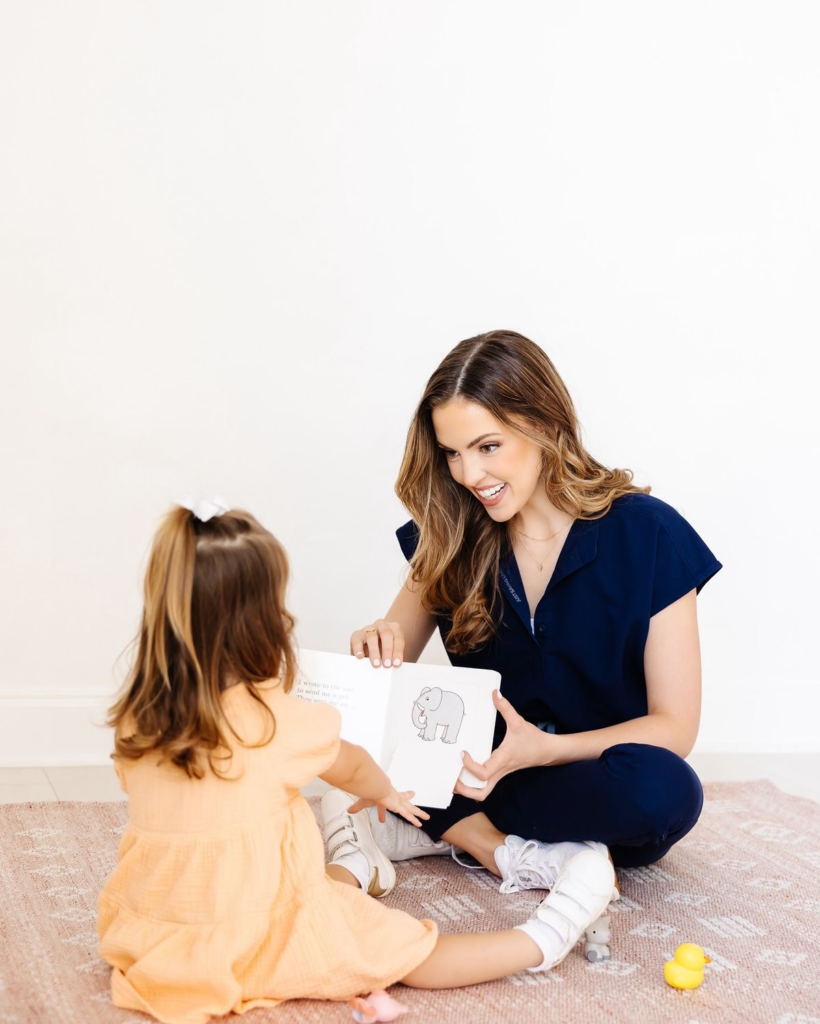
Our paediatric speech therapy team works with children from infancy through to secondary school age. We take time to understand each child as an individual, not just as a set of test scores or a diagnosis on a referral form.
Parents often tell us they were reassured for months to just wait and see. Sometimes that is genuinely the right advice. But if you have been watching and waiting and something still feels off, an assessment is worth doing. It either gives you peace of mind, or it gives you a starting point. Either way, you are better informed.
The conditions and presentations we work with in children include:
- Speech and language delay, supporting children who are talking later than expected or whose language is not developing as it should
- Late talkers, children under three with fewer words than typical for their age but no other identified diagnosis
- Articulation disorders, helping children who mispronounce specific sounds beyond the typical age of correction
- Phonological disorders, where patterns of sound errors affect a child’s overall clarity and how well others can understand them
- Stuttering and fluency difficulties, working with children who repeat sounds, get stuck on words, or begin to avoid speaking in certain situations
- Autism and social communication, including AAC (alternative and augmentative communication) for children who need support beyond spoken language
- Down syndrome, with tailored speech and language support across all stages of development
- Cerebral palsy, with therapy that accounts for the motor and communication complexities involved
- Childhood apraxia of speech (CAS), specialised intervention for children whose brains have difficulty coordinating the movements needed for speech
- Selective mutism, gentle and evidence-based support for children who speak freely at home but go quiet in other settings
- Tongue tie (ankyloglossia), assessment and post-procedure therapy where tongue mobility is affecting feeding or speech
- Feeding and swallowing difficulties in children, supporting safe feeding, oral motor development, and mealtime confidence
- Bilingual and multilingual speech delay, distinguishing true delay from the normal complexity of acquiring more than one language
- Early intervention for children aged zero to three, because the earlier support begins, the greater the impact tends to be
- School-age language and literacy support, for children who are struggling with reading, writing, comprehension, or communication in the classroom
Each of these has its own clinical picture. We assess and treat each one individually. Our dedicated paediatric pages cover every condition in detail, with practical guidance on what to look for, what assessment involves, and how therapy works.
Speech Therapy for Adults
Speech therapy is not only for children. Adults come to us for many different reasons.
Some have lived with a stutter since childhood and are finally ready to address it. Some are professionals who want to communicate more clearly or confidently at work. Some have experienced a stroke or neurological event and are rebuilding language, voice, or swallowing function. Some simply want support with accent modification in a new country.
Adult speech therapy at Next Level Speech and Physiotherapy Center, Dubai, is practical, evidence-based, and focused on outcomes that actually matter in daily life. We do not treat it as a secondary service. It is a clinical specialism in its own right, and our therapists approach it that way.
The areas we work with in adults include:
- Adult stuttering and fluency therapy, for adults who stutter and want effective strategies that hold up in real conversations, not just clinical settings
- Voice disorders and dysphonia, for individuals experiencing hoarseness, vocal fatigue, pitch changes, or voice difficulties affecting daily life or work
- Accent modification, for professionals or individuals wanting to work on clarity, pronunciation, or communication confidence in English or another language
- Aphasia therapy following stroke or brain injury, helping individuals rebuild language comprehension and expression, with support for families too
- Dysphagia and swallowing difficulties in adults, assessment and therapy for those whose swallowing has been affected by neurological conditions, head and neck issues, or ageing
If you are not sure which area applies to you, a general assessment is always a sensible first step. We will help you understand what is going on and what is likely to help.
What to Expect When You Come to Us
Choosing a clinic involves more than reading a list of services. You want to know whether the therapist will actually connect with your child. Whether the assessment will be thorough. Whether you will leave with real answers.
Here is what we try to offer.
Every new client starts with a thorough assessment. For children, this is not a formal test. We observe, interact, and use play-based approaches that feel natural to the child. We also spend real time talking with parents, because you notice things that no standardised tool can capture.
For adults, assessment is detailed and conversational. We want to understand not just the clinical picture but how the difficulty is actually affecting your life, what you have already tried, and what you are hoping for.
After the assessment, we are honest. We tell you what we found, what we think it means, and what a realistic course of therapy might involve. We do not inflate timelines or make promises we cannot keep.
Children’s sessions are built around engagement. Children learn best when they feel safe and interested, so we use games, stories, movement, and creative activities rather than worksheets. Parents are involved throughout because what happens at home between sessions matters just as much as what happens in the room.
Adult sessions are goal-focused and practical. We work on strategies you can actually use, whether that is a job interview, a presentation, a social dinner, or a phone call that does not feel stressful.
A Multilingual Clinic in a Multilingual City
Dubai is one of the most linguistically diverse cities in the world, and the families we see reflect that. Many of our clients are raising children in two or three languages at the same time. Many parents speak to their children in a language that is not their first.
Our team is multilingual, and we are experienced in working across a wide range of linguistic backgrounds. When we assess a bilingual child, we assess appropriately for bilingualism. Mistaking normal bilingual development for speech delay is one of the most common and most avoidable errors in paediatric speech therapy, and it is something we take seriously.
If you would feel more comfortable communicating with our team in a language other than English, please mention it when you get in touch. We will do our best to accommodate you.
Book a Speech Therapy Assessment in Dubai Marina
If something has been sitting with you, an assessment is almost always the right next step.
For children, the early years of development carry real weight. Not in a way that should cause panic, but in the sense that earlier support tends to produce clearer, more lasting outcomes. If you have been wondering whether to act, this is a good moment.
For adults, there is no perfect time to start. But the longer a communication difficulty goes unaddressed, the more it shapes behaviour and confidence in ways that take more time to work through.
We see families from across Dubai Marina, JBR, JLT, Bluewaters, The Greens, Palm Jumeirah, and the wider Dubai community. Our clinic is in Al Fattan Marina Business Hub in JBR, and we offer flexible scheduling to work around school, work, and family life.
To book an assessment or just ask a question before committing to anything, get in touch through our contact page. You can also reach us directly on WhatsApp. There is no pressure involved in reaching out, and we are easy to talk to.
Frequently Asked Questions
- How do I know if my child needs speech therapy or just more time?
Waiting has its place, but so does assessment. If your child is consistently below typical milestones for their age, is hard to understand beyond close family, or shows real frustration around communication, those are meaningful signs. An assessment does not commit you to anything. It simply gives you a clear picture. Many parents tell us they wish they had come sooner, rather than spending months in a cycle of reassurance that never quite settled the worry. - My child is bilingual. Could that explain the delay?
It might, and it might not. Bilingual children can mix languages, progress more slowly in one, or appear to lag behind monolingual peers. This is often completely normal. But if a child has a limited vocabulary across both languages, or is not meeting milestones in either, that is worth assessing properly. Our therapists are trained in bilingual speech and language development and will not misread typical bilingual patterns as delay. - What does a paediatric speech therapy assessment involve?
It is designed not to feel like a test. We use play-based activities, structured observation, and age-appropriate tools to get a picture of how your child communicates in different situations. We also spend real time talking with you, because parents notice things that structured sessions can miss. After the assessment, we share findings clearly and give an honest recommendation on whether therapy is indicated and what it would involve. - What does an adult speech therapy assessment look like?
It is a detailed clinical conversation combined with structured tasks specific to the area of concern. Whether we are looking at fluency, voice, language following a neurological event, or swallowing function, the assessment is thorough and designed to produce a clear picture. We share findings in plain language and talk through realistic options for therapy. - How long does a course of speech therapy usually take?
It depends on the person and the nature of the difficulty. Some children make strong progress within three to four months of consistent therapy. Others benefit from longer support, particularly where there is an underlying developmental or neurological condition. We review progress regularly and adjust the plan as things develop. We will always be honest with you about where things stand and what is still worth pursuing. - Do you involve parents in children’s therapy sessions?
Yes, and we consider this central to how our paediatric therapy works. What a child learns in a session needs to be reinforced in daily life to really take hold. We work with parents to build confidence in supporting communication at home, in ways that fit naturally into routines rather than feeling like extra homework. - Do I need a referral letter from a doctor?
No. You can self-refer directly. Many of our clients come to us without any formal referral. They have simply noticed something and decided to act on it. We also receive referrals from paediatricians, neurologists, school SENCOs, and other allied health professionals. If you are unsure about the process, reach out through our contact page and we will guide you through it. - Do you work with children who have already been assessed elsewhere?
Yes. We regularly see children who come with existing reports, previous therapy histories, or assessments done in other countries. Previous reports are helpful context, but we always conduct our own assessment to form a current picture rather than relying on documentation that may be months or years old. - Is the clinic easy to reach from JLT or Palm Jumeirah?
Our clinic is in Al Fattan Marina Business Hub in JBR, which is easy to reach from JLT, Dubai Marina, Palm Jumeirah, Bluewaters, and The Greens. Many of our families travel from across these communities for regular sessions. We offer appointment times across the week to make attendance manageable, including options outside standard working hours where possible. - What if my child is anxious or refuses to take part in sessions?
This is more common than many parents expect, and our therapists are experienced in working with children who are shy, anxious, or initially reluctant. We never force participation or create situations that feel pressured. Sessions are built around comfort and connection first. Most children relax and begin to engage naturally once they feel safe with their therapist. For children with selective mutism or significant anxiety, we use approaches designed specifically for this.