There is a particular kind of frustration that comes after a medical event. The acute phase is over. The doctors are satisfied with the numbers. And yet the person sitting at home cannot manage a button, cannot get through a morning routine without exhaustion, cannot return to the job they held for twenty years. The clinical picture looks fine. Daily life does not.
That gap is what adult occupational therapy addresses.
At Next Level Speech and Physiotherapy Center, Dubai, our adult OT team works with people whose ability to function in daily life has been affected by illness, injury, neurological change, or the accumulated weight of a mental health difficulty. The focus is always practical: not a benchmark on a chart, but a specific thing the person needs to be able to do.
What Adult OT Covers
Occupational therapy for adults is concerned with the tasks that make up a functioning life. Work, self-care, managing a home, returning to leisure activities, maintaining independence as circumstances change. When any of these become significantly harder than they should be, OT identifies what is driving that difficulty and builds a structured path toward restoring function.
The approach varies depending on the person and their situation. For someone recovering from a stroke, the work looks different than it does for someone managing a progressive neurological condition or returning to work after a period of serious mental health difficulty. What stays consistent is the functional focus: we are always working toward something real and specific in that person’s life.
What We Help With
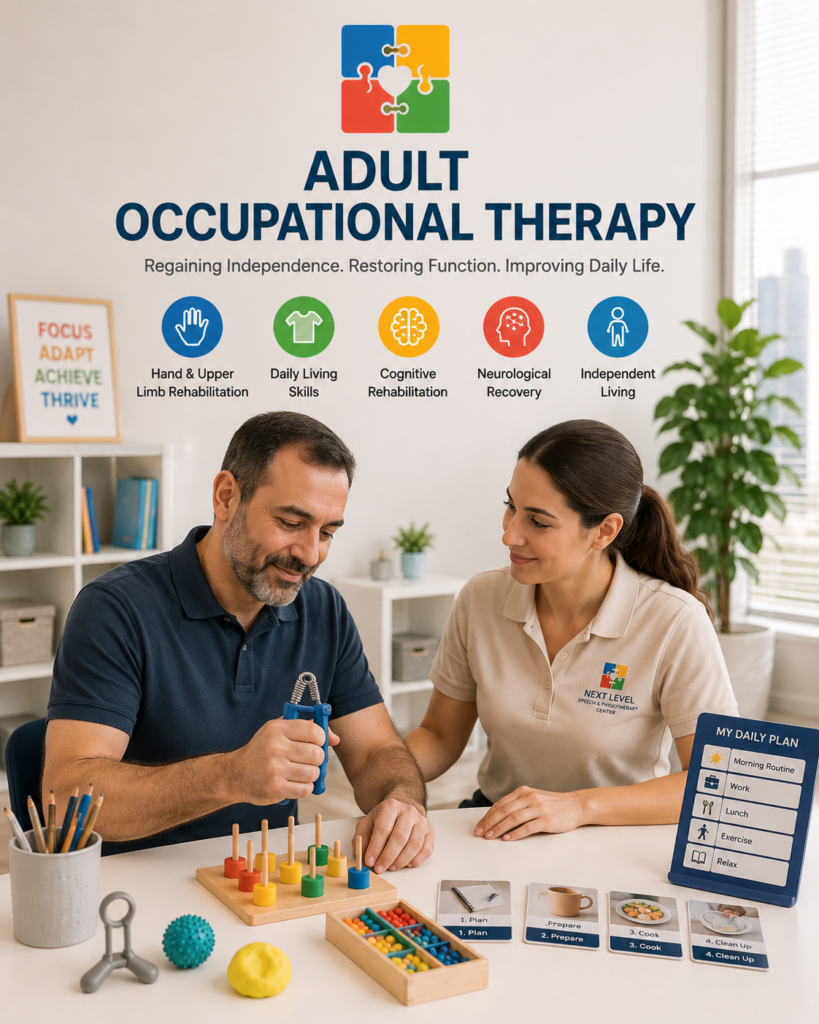
Post-Stroke Rehabilitation and Daily Living Skills After a stroke, relearning daily tasks, dressing, preparing food, and managing personal care is often harder and more time-consuming than people expect. OT addresses this directly, breaking each task into its component parts and retraining the motor and cognitive sequences involved. The goal is independence in the specific activities that matter most to the person, not generic rehabilitation milestones.
Hand and Upper Limb Rehabilitation Hand injuries, surgeries, and conditions affecting grip, dexterity, or arm function can affect almost every aspect of daily life. OT addresses the functional side of recovery: retraining fine motor skills, building grip strength progressively, and working toward return to the specific tasks the person needs their hands for, whether that is cooking, writing, or returning to work.
Neurological Conditions (MS, Parkinson’s, and Traumatic Brain Injury) For adults living with progressive or acquired neurological conditions, OT focuses on maintaining independence for as long as possible and adapting strategies as the condition changes. This involves fatigue management, cognitive strategies, adaptive equipment, and home or workplace modifications. The work is planned around the person’s current function and realistic trajectory, not a fixed recovery endpoint.
OT for Mental Health (Anxiety, Depression, and Burnout) Mental health difficulties affect the ability to function in ways that are practical as much as emotional. Getting out of bed, maintaining a routine, returning to work, and re-engaging with daily life after a significant episode. OT for mental health addresses the structural and functional side of recovery: building routines, grading activity back up gradually, and creating environments that support daily function alongside whatever other treatment the person is receiving.
Work and Vocational Rehabilitation Returning to work after illness, injury, or burnout involves more than medical clearance. It involves rebuilding the functional capacity the role requires, understanding what adjustments the workplace may need, and managing the transition back in a way that is sustainable. OT supports this process through functional assessment, graded return-to-work planning, ergonomic advice, and practical preparation for the specific demands of the person’s role.
OT for Older Adults and Aging Independence As people age, tasks that were straightforward become less so. OT for older adults focuses on maintaining independence at home, reducing fall risk, identifying and introducing adaptive equipment, and helping families understand what modifications or support will make the most difference. The aim is to extend the period of safe, confident independence for as long as possible.
How Assessment Works
Assessment at Next Level Speech and Physiotherapy Center, Dubai, maps current functional ability against what daily life actually requires. This involves a structured conversation about the person’s situation, their goals, and the specific tasks they are finding difficult, alongside direct observation and standardized tools where appropriate.
The findings are communicated clearly, with time to ask questions. A therapy plan follows from there, built around the person’s specific goals and circumstances rather than a standard protocol. Adults who come with complex or overlapping needs, physical and cognitive, or physical and mental health, receive a plan that addresses both dimensions.
Why Adults Choose Next Level Speech and Physiotherapy Center, Dubai
The clinic is in JBR, accessible from Dubai Marina, JLT, Palm Jumeirah, Bluewaters, and The Greens. Appointment scheduling is flexible and can be arranged around work or carer commitments. The team includes therapists who work across languages, which matters in a city as internationally mixed as Dubai.
All therapists hold DHA licensure. When a person’s recovery involves both OT and physiotherapy, or OT and speech therapy, those teams work alongside each other. Progress across disciplines is coordinated, not managed in separate silos.
Book an Adult OT Assessment
If daily life has become harder than it should be, whether that happened suddenly or gradually, an assessment is the right starting point. It gives a clear picture of what is driving the difficulty and what therapy can realistically address.
Adults and families from across Dubai Marina, JBR, JLT, and surrounding communities are welcome to reach out through our contact page or message us on WhatsApp. For a full overview of all occupational therapy services at the clinic, visit our occupational therapy page.
Frequently Asked Questions
Who is adult OT for? Adult OT is for anyone whose ability to manage daily life has been affected by a medical event, a chronic condition, a mental health difficulty, or the changes that come with aging. You do not need a specific diagnosis to seek an assessment. If daily tasks are significantly harder than they used to be and that difficulty is affecting your quality of life, that is reason enough to come in.
How is adult OT different from physiotherapy? Physiotherapy focuses primarily on movement, strength, pain, and physical rehabilitation. OT focuses on function: the ability to carry out the tasks that make up daily life. A physiotherapist might work on restoring the range of motion in a shoulder. An OT works on using that shoulder to get dressed, prepare food, or return to work. The two disciplines regularly work alongside each other at the clinic.
Do I need a referral from a doctor to access adult OT? Not necessarily. Many adults come to us directly after an injury, diagnosis, or period of difficulty without a formal referral. If your insurer requires a referral for coverage purposes, we recommend checking that before your first appointment. The assessment itself does not require one.
What happens in the first session? The first session is an assessment. The therapist will ask about your medical history, your daily routine, the specific tasks you are finding difficult, and your goals. There will be some structured observation and possibly standardized assessments depending on your situation. You will leave with a clear understanding of what the assessment found and what therapy will involve.
How long does adult OT take? This varies depending on the person’s condition and goals. Someone recovering from a hand injury with clear functional targets may reach them within a few months. Someone managing a progressive neurological condition will benefit from longer-term support as their needs evolve. The therapist will give a realistic picture of what to expect after the assessment.
Can OT help if I am struggling with burnout rather than a physical condition? Yes. Burnout affects the ability to function in daily life in ways that are practical as well as emotional. OT addresses the structural side of recovery: rebuilding routines, grading activity back up, and creating conditions that support a sustainable return to work and daily life. It works alongside other support the person may be receiving, not instead of it.
Is adult OT available at home for people who cannot travel to the clinic? Please contact us directly to discuss your situation. We can advise on what options are available depending on the person’s circumstances and location.
Is adult OT covered by health insurance in Dubai? Many health insurance policies in the UAE include adult OT coverage, but it varies by provider and plan. We recommend contacting your insurer before your first appointment to confirm what is covered. The clinic can provide the documentation required for insurance claims.
Can OT help an older family member who wants to stay independent at home? Yes. OT for older adults focuses specifically on maintaining independence, reducing fall risk, and identifying what modifications or equipment will make the biggest practical difference at home. We work with the person directly and with family members who are involved in their care.
What if my needs involve both physical and mental health factors? This is more common than people assume, and OT is well-placed to address both dimensions. The functional impact of mental health difficulty is a legitimate OT concern alongside physical rehabilitation, and our therapists are experienced in working with adults whose situations involve both. The therapy plan will reflect the full picture, not just one part of it.