
Some children make it through the morning routine without incident. Others treat every step of it, getting dressed, eating breakfast, packing a bag, as a separate negotiation. Parents notice these things long before anyone gives them a name, and they are right to notice.
Occupational therapy works with exactly that gap: between what daily life asks of a person and what they can currently manage. At Next Level Speech and Physiotherapy Center, Dubai, our OT team works with children and adults whose everyday functioning, the practical business of moving through a day, requires more than it should.
What Occupational Therapy Addresses
The word “occupational” confuses people. It sounds like careers. What it actually refers to is everything a person does as part of daily life. For a four-year-old, that’s dressing, eating, playing, and sitting still long enough to learn something. For an adult recovering from a stroke, it’s getting back to the routines that make life feel like their own again.
OT identifies where those functions are breaking down and builds a structured path toward greater independence. The focus is always specific: a child who can hold a pencil without tiring, an adult who can prepare a meal, a teenager who can manage their own morning without prompting.
Who We Work With
Our occupational therapy team works with children from toddler age through the school years, and with adults across a range of conditions and life stages.
For children, OT addresses the sensory, motor, cognitive, and behavioral foundations that underpin daily functioning. When those foundations are unsteady, everything built on them becomes harder. Learning, socializing, self-care, managing a classroom. Many families across Dubai Marina and JBR come to us having noticed something is off long before a formal diagnosis exists.
For adults, OT addresses the gap that opens after injury, illness, or a significant neurological event. Not just the physical side. The practical logistics of an independent life.
Pediatric Occupational Therapy
Some differences in children go beyond typical developmental variation. A child who finds ordinary textures unbearable. A six-year-old whose pencil grip hasn’t developed the way it should. A child who falls apart at transitions that other children move through without a second thought.
Our pediatric OT team assesses each child individually before building a therapy plan around their specific profile. Sessions are structured enough to build real skills and relaxed enough for children to engage without pressure. Parents are closely involved throughout, with practical guidance on supporting progress between appointments.
Pediatric OT at the clinic covers sensory processing difficulties, fine and gross motor delays, handwriting challenges, self-care and daily living skills, school readiness, attention and executive function, and OT support for children with autism, ADHD, and developmental coordination disorder. Each of these is covered in detail on our pediatric occupational therapy page.
Adult Occupational Therapy
Life shifts after a stroke, a neurological diagnosis, a significant injury, or a period of serious mental health difficulty. The medical side tends to get attention. What often gets less attention is the practical question: how does someone get back to doing the things that make up their life?
That is what adult OT addresses. Our therapists work with adults on post-stroke rehabilitation and daily living retraining, hand and upper limb rehabilitation, neurological conditions including MS, Parkinson’s, and traumatic brain injury, mental health and functional recovery, vocational rehabilitation, and strategies for older adults managing independence at home.
The approach is always functional. Not a clinical benchmark in isolation. A specific thing a person needs to be able to do. Full details are on our adult occupational therapy page.
Assessment
Every OT path at Next Level Speech and Physiotherapy Center, Dubai starts with a comprehensive assessment. For children, this involves structured observation, standardized tools appropriate to the child’s age and presentation, and a conversation with parents about what they are seeing at home and at school. For adults, the assessment maps current functional ability against what daily life actually requires.
Findings are communicated clearly, with time for questions. A therapy plan follows, specific to the person, not a standard protocol applied uniformly across everyone who walks through the door.
Why Families and Adults Come to Us
The clinic is in JBR, which puts it within easy reach of Dubai Marina, JLT, Palm Jumeirah, Bluewaters, and The Greens. Appointments are arranged around school hours and work schedules. The team includes therapists who work across languages, which is relevant in a city as internationally mixed as Dubai.
All therapists hold DHA licensure. The clinic space is calm and purposeful, designed to be manageable for children with sensory sensitivities without feeling clinical in a way that creates its own anxiety.
When a child needs both OT and speech therapy, or when an adult’s recovery touches both OT and physiotherapy, those teams communicate. Progress doesn’t get siloed between disciplines.
Book an Occupational Therapy Assessment
An assessment is the right first step, whether something has been nagging at you for months or whether a school or doctor has flagged a concern. It gives clarity, and clarity makes everything that follows easier to act on.
Families and adults from across Dubai Marina, JBR, and surrounding communities are welcome to reach out through our contact page or message us on WhatsApp. You can also explore the full scope of what our OT team offers through our pediatric occupational therapy and adult occupational therapy pages.
Frequently Asked Questions
What is occupational therapy, and how does it differ from physiotherapy? Physiotherapy focuses primarily on movement, strength, and physical rehabilitation. OT focuses on function: the ability to carry out the tasks that make up daily life. A physio might help someone regain strength in their arm after a stroke. An OT works on using that arm to button a shirt, prepare food, or get back to work. The two regularly run alongside each other at the clinic.
At what age can a child start occupational therapy? OT can begin as early as infancy, where there are developmental concerns. Most pediatric referrals involve children between two and seven, but OT is appropriate at any point through adolescence. The earlier support starts, the more it can shape the foundations that everything else builds on, but later referrals are not too late.
How do I know if my child needs OT rather than speech therapy? Speech therapy addresses communication, language, and swallowing. OT addresses sensory processing, motor skills, self-care, and daily function. There is overlap, and some children benefit from both. If you are unsure, an assessment will clarify which areas need support and in what order.
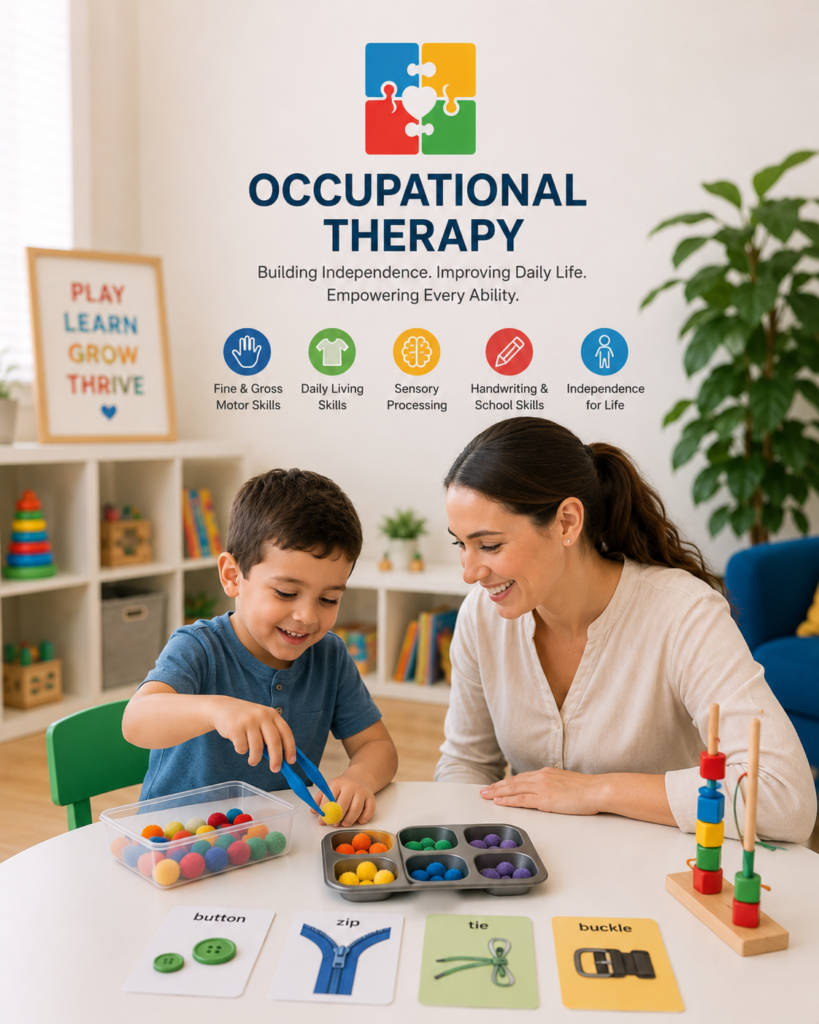
What does a pediatric OT session look like? Sessions are built around activities that look like play but are chosen specifically to build a skill. A therapist working on fine motor development might use threading, drawing, or construction tasks. A therapist targeting sensory regulation might use movement and proprioceptive input. The child leads within a structure the therapist shapes around them.
How long does OT typically take? This depends entirely on the child’s profile and goals. Some children reach their targets within a few months. Others benefit from longer-term support, particularly where an underlying condition means ongoing needs. The assessment will give a realistic picture of what to expect, including a proposed frequency and duration.
Can adult OT help with mental health difficulties, not just physical conditions? Yes. OT for adults with mental health difficulties focuses on the practical side of recovery: rebuilding routines, grading activity back up, and creating environments that support daily function. It works alongside mental health treatment rather than replacing it, and it addresses the parts of recovery that therapy alone often doesn’t reach.
Do you work with adults who have progressive neurological conditions? Yes. For conditions like Parkinson’s or MS, the OT focus shifts toward maintaining independence for as long as possible and adapting strategies as needs change. This requires a different kind of planning than post-injury rehabilitation, and the clinic’s therapists are experienced in both.
Is occupational therapy covered by health insurance in Dubai? Many health insurance policies in the UAE include OT coverage, but it varies significantly by provider and plan. We recommend contacting your insurer directly before your first appointment. The clinic can provide documentation to support insurance claims where needed.
Do parents need to attend their child’s OT sessions? For younger children, a parent or caregiver is usually present for at least part of the session. For older children, it often works better for the therapist to work with the child independently, with an update at the end. Regardless of the format, what happens at home between sessions matters. The clinic provides parents with specific guidance to support what is happening in the room.
What is the difference between OT for autism and ABA therapy? ABA therapy focuses on behavior: teaching, reinforcing, and generalizing specific skills and reducing behaviors that affect daily functioning. OT for autism focuses on the sensory, motor, and daily living dimensions: managing sensory sensitivities, building fine motor skills, and developing the practical independence skills that underpin daily life. Many children benefit from both, and at Next Level Speech and Physiotherapy Center, Dubai, those teams work alongside each other.