Building Peer Interaction, Communication, and Cooperative Play for Children | Next Level Speech and Physiotherapy Center, Dubai
The birthday party invitation sits on the kitchen counter and a parent feels two things at once — glad their child was included, and quietly anxious about what the afternoon will actually look like. Will their child know how to join the group? Will they manage when someone takes the toy they wanted? Will they find the noise and the chaos too much, and spend the whole time at the edge of the room?
Social skills are not instinctive for every child. For children with autism, ADHD, developmental delays, or social communication difficulties, the unwritten rules of peer interaction — when to speak, how to take turns, how to read what another child is feeling, how to repair a moment that went wrong — do not come automatically. They need to be taught. Directly, systematically, and with enough practice that they become reliable.
That is what the social skills program at Next Level Speech and Physiotherapy Center, Dubai is built to do.
What Social Skills Training Actually Addresses
Social competence is not a single skill. It is a cluster of interconnected abilities that children typically develop gradually through observation, imitation, and thousands of small social interactions over the early years of life. For children who find that process difficult, the gap between what they can do socially and what their peers expect of them tends to widen as they get older.
The skills this program targets include:
- Initiating interaction — approaching another child, starting a conversation, joining a game already in progress
- Reading social cues — understanding facial expressions, body language, tone of voice, and the unspoken signals that tell you when someone is interested, bored, upset, or uncomfortable
- Turn-taking and sharing — in conversation and in play, recognizing that interaction is reciprocal and requires both giving and receiving
- Managing disagreement — handling situations where things do not go as expected, someone breaks a rule, or a conflict needs to be resolved without losing control
- Cooperative play — working alongside or with another child toward a shared goal, negotiating, and adjusting to what the other person needs
- Conversation skills — staying on topic, asking questions, listening, knowing when to talk and when to stop, and shifting the subject naturally
These are not soft or optional skills. They are what determine whether a child can make and keep friends, function in a classroom, and participate in the social world of childhood.
Who This Program Is For
Social skills training through ABA at Next Level Speech and Physiotherapy Center, Dubai is appropriate for children across a range of presentations. The common factor is not a specific diagnosis — it is a gap between the child’s current social functioning and what they need to participate meaningfully in peer relationships and group settings.
Children who typically benefit include those with autism spectrum disorder who have functional language but struggle with the pragmatic and reciprocal aspects of social interaction. Children with ADHD whose impulsivity disrupts peer relationships — speaking over others, grabbing, reacting before thinking. Children with social anxiety or selective mutism who have the social understanding but freeze when it comes to actually engaging. Children with developmental delays who are approaching school age and need to build the interaction skills that classroom and playground life will demand.
Age matters to the shape of the program but not to eligibility. A four-year-old working on parallel play and basic turn-taking needs a different program from an eight-year-old working on conversational repair and managing group dynamics. Both are appropriate for this program.
How Skills Are Assessed
Before any social skills program begins, our therapist completes an assessment of the child’s current social functioning. This involves direct observation of the child in interaction, structured tasks designed to reveal specific skill gaps, and a detailed conversation with parents about what they are observing at home, at school, and in social situations.
The assessment identifies which skills are absent, which are emerging but inconsistent, and which are present but not yet generalizing to real-world situations. This distinction matters. A child who can take turns in a one-to-one therapy task but cannot manage it on the playground needs different work from a child who has never demonstrated turn-taking in any context.
From the assessment, the therapist designs a program with specific, measurable goals ordered by priority and developmental logic. Skills that other skills depend on come first.
How the Program Works
Social skills are taught using the core methods of ABA — breaking each skill into component steps, teaching those steps explicitly, providing immediate and meaningful reinforcement for successful attempts, and collecting data to track progress and guide adjustments.
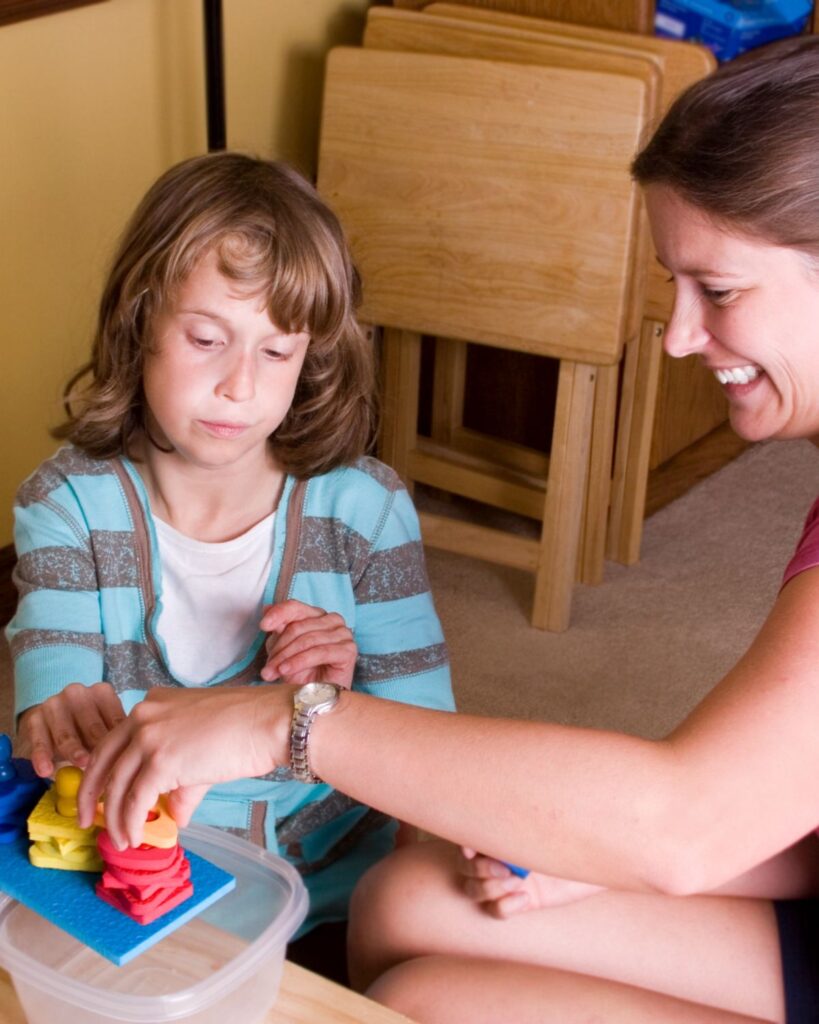
For younger children, the teaching is embedded in play. A therapist working on turn-taking with a five-year-old uses a game the child loves as the vehicle — the skill is taught within a context that feels natural and engaging, not as an abstract exercise. For older children, more explicit instruction is used alongside practice — explaining the social rule, modeling it, practicing it in a structured scenario, and then working toward using it in more naturalistic situations.
Role-play is a central tool. Children practice social scenarios in a safe, low-stakes environment before being expected to apply them in real interactions. What does it look like to join a group of children already playing? What do you say when you accidentally bump someone? How do you respond when a friend says something that upsets you? These scenarios are practiced until the response begins to feel automatic rather than effortful.
Progress is tracked across every session. Social skills development is not left to hope — it is measured, reviewed, and adjusted based on what the data shows.
Taking Skills Into the Real World
The goal of social skills training is never competence in the clinic room. It is competence on the playground, in the classroom, at the birthday party, and in every other setting where children need to connect with each other.
Generalization — the transfer of skills from the teaching context to real-world situations — is built into the program design from the start. This means practicing skills across different people, different settings, and different levels of complexity. It also means involving parents directly, so that the strategies being used in sessions are reinforced in the child’s daily life outside the clinic.
We work with families to identify the specific social situations that are most challenging for their child and ensure the program is pointed directly at those situations. A child heading into a new school in JLT needs different preparation from a child whose primary challenge is managing playdates in a Dubai Marina apartment.
Parent training sessions are available for families who want a deeper understanding of how to support social skills development at home and in the community.
What Progress Looks Like
Social skills development is cumulative and sometimes slow to become visible. A child can be building skills in sessions for several weeks before those skills begin to show up reliably in real-world interactions. When they do, the change tends to be meaningful — a child who previously stood at the edge of the playground begins approaching other children. A child who used to end every playdate in a meltdown begins managing disagreements. A child who could not maintain a conversation for more than one exchange begins sustaining back-and-forth interaction.
These shifts have consequences beyond the immediate social moment. Children who develop stronger social competence tend to become more confident, more willing to attempt new social situations, and less reliant on adult intervention to manage peer relationships. Families across JBR, Dubai Marina, Palm Jumeirah, and The Greens have described this progression as one of the most significant changes they have seen from any therapy their child has received.
Why Next Level Speech and Physiotherapy Center, Dubai
Our therapists are DHA-licensed and trained in behavioral intervention with specific experience in social communication and peer interaction goals. Because our clinic is multidisciplinary, children who also need speech therapy support for the language and pragmatic components of social communication can access that in the same building, with programs coordinated between therapists.
Social skills and language are deeply intertwined. A child who does not yet have the language to express disagreement appropriately cannot be expected to manage conflict through words. When speech therapy and ABA social skills work run in parallel and in coordination, progress across both areas tends to accelerate.
The clinic is in JBR, accessible from Dubai Marina, JLT, Bluewaters, and surrounding communities. Scheduling options include after-school and weekend availability where possible for school-age children.
Book a Social Skills Assessment
If your child is struggling to connect with peers, finding group situations difficult, or missing the social milestones that other children seem to manage naturally, an assessment is the most useful first step. It will give you a clear picture of exactly where the gaps are and what a structured program of support can realistically offer.
Reach our team through our contact page to book an assessment or ask anything you need answered first. You can also message us directly on WhatsApp. Our full range of ABA programs is outlined on our ABA therapy page.
Frequently Asked Questions
At what age can children start social skills training? Social skills training can begin as early as three to four years old, when peer interaction first becomes a meaningful part of a child’s daily life. The goals and methods shift significantly with age — a preschooler working on parallel play and basic turn-taking needs a very different program from a nine-year-old working on conversational reciprocity and managing group dynamics. There is no upper age limit for the program.
My child has autism and can talk fluently. Do they still need social skills training? Verbal fluency and social competence are not the same thing. Many children with autism who speak well still find the reciprocal, pragmatic aspects of social interaction genuinely difficult — reading between the lines, understanding what someone means rather than what they said, knowing when to stop talking, managing the unwritten rules of group play. These are precisely the skills this program targets, and verbal children with autism frequently make strong progress with structured social skills training.
How is ABA social skills training different from a social skills group? A social skills group provides peer interaction practice in a structured setting, which is valuable. ABA social skills training is more individualized — goals are set specifically for your child, teaching is systematic and data-driven, and progress is tracked and adjusted based on evidence. The two approaches can complement each other. Some children benefit from individual ABA social skills work alongside a peer group setting.
Will my child be practicing with other children or just with the therapist? Both, depending on the stage of the program. Early teaching often happens in a one-to-one setting with the therapist, where the child can practice skills safely before being expected to use them with peers. As skills develop, practice with other children becomes more central — through structured peer activities in the clinic, through sibling interaction at home, and through naturalistic social situations in the community.
My child knows what they should do socially but freezes when the moment comes. Can ABA help with that gap? Yes. The gap between knowing a rule and being able to apply it in the moment is a common pattern, particularly in children with anxiety or social communication difficulties. ABA addresses this through repeated, graduated practice — starting in low-pressure scenarios and progressively moving toward situations that more closely match the real ones the child finds difficult. The goal is for the response to become automatic enough that cognitive overload in the moment does not prevent it.
How does the program help with school and classroom situations specifically? School readiness and classroom social functioning are frequent goal areas in this program, particularly for children approaching school entry or moving into a new school year. Goals can include managing group work, navigating the playground, handling conflict with classmates, and understanding classroom social norms. With parental consent, we can provide strategies that parents share with teachers to ensure consistency between the clinic and the classroom.
Can social skills training help with my child’s emotional regulation during social situations? Yes. Emotional dysregulation during social interaction — big reactions when things go wrong, difficulty recovering from a social setback — is a common challenge for children with autism or ADHD, and it is addressed directly in this program. Building emotional regulation skills alongside social skills gives children both the understanding of what to do and the capacity to do it even when they are frustrated or overwhelmed.
How long does it take to see progress in social skills? Social skills development is generally slower to show up in real-world behavior than some other ABA goal areas, because the generalization step is more complex. Children often build skills in sessions over several weeks before those skills begin appearing reliably in natural social situations. When they do appear, however, the change tends to be durable. Families should expect a program of at least three to six months before drawing conclusions about overall progress.
Do you offer any group-based social skills sessions alongside individual therapy? Reach out to our team to ask about current availability. Group formats for social skills practice are a natural complement to individual ABA work and we are happy to discuss what options exist at the time of your inquiry.
What role do parents play in social skills training? A significant one. Parents are the people best placed to create and support social opportunities in the child’s daily life outside the clinic — arranging playdates, attending group activities, coaching the child through difficult social moments in real time. We share the strategies used in sessions with parents so that support at home is pointed in the same direction as the therapy. Dedicated parent training sessions are available for families who want a structured grounding in how to support social development across daily life.