
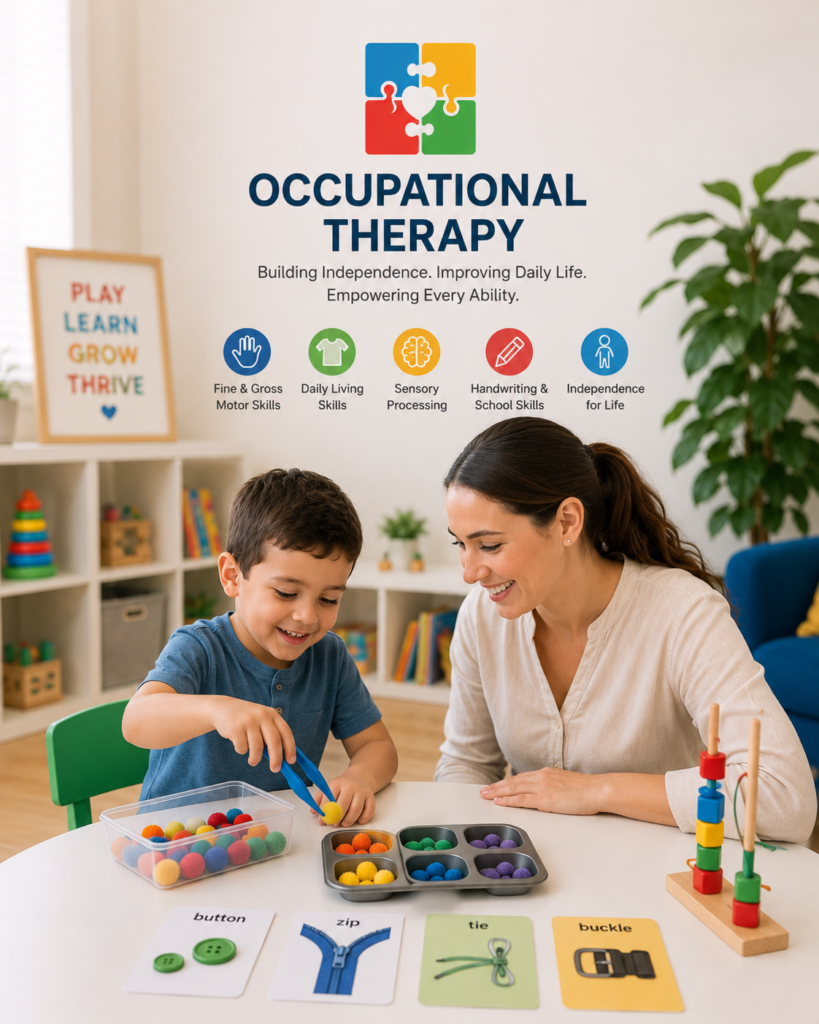
The school report said he was “easily distracted” and “struggling to keep up with written work.” His teacher was kind about it. But sitting across from her, his mother knew the words on that page didn’t come close to describing what mornings looked like at home. The forty-five minutes it took to get dressed. The meltdown over a tag in his shirt. The way he held his pencil was as if it were something foreign to him.
These are not behavioral problems. They are signals. And occupational therapy starts with learning to read them.
At Next Level Speech and Physiotherapy Center, Dubai, our pediatric OT team works with children whose daily functioning, at home, at school, and in the spaces between, requires more support than typical development provides. Some of these children have a diagnosis. Many do not yet.
What Pediatric OT Covers
Occupational therapy for children is concerned with the skills that underpin daily life: the ability to dress independently, hold a pencil, sit comfortably in a classroom, manage a fork, tolerate a busy environment, and engage in play with other children. When those skills are delayed, uneven, or significantly harder to acquire than expected, OT provides a structured path toward building them.
The work is not about compliance or correction. It is about understanding why a child is struggling and addressing the root of it rather than managing the surface behavior.
What We Help With
Sensory Processing Disorder Some children find ordinary sensory input, such as a clothing tag, a busy hallway, or the hum of a classroom, genuinely overwhelming in ways that affect their ability to function. Others seek sensory input constantly and struggle to regulate without it. Our therapists assess how a child’s nervous system is processing sensory information and build a plan that helps them manage their environment more comfortably.
Fine Motor Skills Delay Fine motor skills underpin a large portion of what children are asked to do at school and at home: writing, cutting, buttoning, using cutlery, and managing a zipper. When those skills are delayed, daily tasks become exhausting. OT builds the strength, coordination, and motor planning that make them manageable.
Handwriting Difficulties and Dysgraphia For some children, handwriting remains effortful, inconsistent, or illegible despite practice and effort. The issue is rarely about trying harder. OT addresses the underlying motor, perceptual, and coordination factors that make forming letters difficult, and works toward handwriting that is functional and less fatiguing.
Sensory Integration Therapy Sensory integration therapy is a specific OT approach used with children whose nervous systems struggle to organize and respond to sensory input effectively. It is delivered in a structured, play-based environment using equipment and activities designed to give the nervous system the input it needs to regulate. Many parents search for this directly after a sensory processing or autism diagnosis.
Self-Care and Daily Living Skills Dressing, toileting, eating, managing a school bag. These are the tasks that structure a child’s day, and when they are significantly harder than expected for the child’s age, the impact is felt by the whole family. OT breaks these tasks into teachable steps and builds independence gradually, with practical home strategies that support what happens in the clinic.
Feeding therapy is part of this work. For children who have a restricted diet, strong food refusals, difficulty managing utensils, or significant mealtime distress, our OT team addresses the sensory, motor, and behavioral factors involved. Where oral motor function or swallowing is also a concern, our speech therapy team works alongside OT directly.
Attention, Focus, and Executive Function Some children struggle to sustain attention, shift between tasks, organize their thoughts, or manage their impulses in ways that go beyond typical childhood behavior. OT addresses the sensory and neurological factors that underlie these difficulties, building the self-regulation and organizational skills that allow children to function more effectively at school and at home.
Occupational Therapy for Autism Children with autism often experience sensory sensitivities, motor differences, and challenges with daily living skills that sit alongside the communication and behavioral dimensions of the condition. OT addresses these specific areas: building tolerance for sensory input, developing fine and gross motor skills, and supporting independence in daily routines. It works alongside ABA therapy rather than overlapping with it.
Occupational Therapy for ADHD ADHD affects more than attention. It affects organization, motor planning, sensory regulation, and the ability to move through a structured day. OT for children with ADHD focuses on the practical and functional side of these challenges, building skills and strategies that help children manage their environment rather than be managed by it.
Developmental Coordination Disorder (DCD and Dyspraxia) Children with DCD are often described as clumsy, slow to learn new physical skills, or significantly behind their peers in coordination, despite normal intelligence and motivation. OT assesses the motor planning and coordination difficulties involved and builds a therapy plan that targets the specific movements and sequences the child finds hardest.
Visual Motor Integration and Perceptual Skills Some children struggle to copy from a board, complete puzzles, track across a line of text, or understand spatial relationships, not because of a vision problem but because the connection between what they see and what their hands do is not working efficiently. OT assesses and addresses these visual-motor gaps directly, which often has a significant effect on academic performance.
School Readiness and Pre-Writing Skills For children approaching KG1 or early primary school, OT can address the foundational skills that classroom learning depends on: pencil control, sitting at a desk, following multi-step instructions, scissor skills, and the sensory-motor foundations that make early learning possible. Addressing these before a child enters school reduces the gap they would otherwise have to close while simultaneously managing new academic demands.
How We Assess and What to Expect
Assessment at Next Level Speech and Physiotherapy Center, Dubai involves structured observation, standardized tools appropriate to the child’s age, and a conversation with parents about what they are seeing at home and at school. It is not a checklist. It is a process that looks at the whole child.
Findings are shared clearly after the assessment. Parents leave knowing what their child’s profile looks like, which areas are strongest, where the gaps are, and what therapy will target. There is always time for questions.
Sessions are structured around activities that feel purposeful to the child rather than clinical. Parents receive practical home guidance after each session, specific to what their child is working on. Progress in OT rarely happens in the clinic alone.
Why Families Choose Next Level Speech and Physiotherapy Center, Dubai
The clinic is in JBR, within reach of Dubai Marina, Palm Jumeirah, Bluewaters, The Greens, and JLT. Appointments are arranged around school hours. The team includes therapists who work across languages, and all hold DHA licensure.
When a child’s needs overlap with speech therapy or another service at the clinic, those teams communicate directly. The work is coordinated, not siloed.
Book a Pediatric OT Assessment
If something has been on your mind about your child’s development, an assessment is the clearest next step. It does not require a referral or a formal diagnosis. It requires a parent who has noticed something and wants to understand it better.
Families from across Dubai Marina, JBR, JLT, and surrounding communities are welcome to get in touch through our contact page or reach us on WhatsApp. For a full overview of all occupational therapy services at the clinic, visit our occupational therapy page.
Frequently Asked Questions
Does my child need a diagnosis before starting OT? No. Many children who come to us do not yet have a formal diagnosis. A parent’s observation that something is not right is enough reason to seek an assessment. The assessment itself will identify the areas of difficulty and what is driving them, which often informs any diagnostic process that follows.
How do I know if my child needs OT or speech therapy? Speech therapy addresses communication, language, and swallowing. OT addresses sensory processing, motor skills, self-care, and daily function. The two often overlap, and some children benefit from both. If you are unsure which applies, an OT assessment will clarify what is driving the difficulties you are seeing.
What age groups do you work with? We work with children from toddler age through adolescence. For children under three, early intervention tends to be the most impactful stage. For school-age children, OT addresses academic and social functioning alongside daily living skills. Adolescents often benefit from OT focused on independence and preparation for secondary school demands.
How long are sessions and how frequently will my child be seen? Sessions are typically between 45 and 60 minutes. Frequency depends on the child’s needs and is confirmed after the initial assessment. Some children attend weekly, others fortnightly. The therapist will recommend what they believe will produce the best results for your child’s specific profile.
Will OT help my child at school? For many children, improvements in fine motor skills, attention, sensory regulation, and self-organization directly affect classroom functioning. Our therapists can also liaise with schools where appropriate and advise on strategies teachers can use alongside what is happening in therapy.
What if my child is resistant to attending sessions? This is common, especially early on. Our therapists are experienced in working with children who are anxious or uncertain about therapy. Sessions are paced to the child, and most settle into the routine within a few visits. We also work with parents on how to frame sessions at home in a way that reduces resistance.
Is pediatric OT covered by health insurance in Dubai? Many health insurance policies in the UAE include OT coverage for children, but coverage varies by provider and plan. We recommend contacting your insurer before the first appointment. The clinic can provide the documentation insurers typically require for claims.
How involved do I need to be as a parent? Closely involved. For younger children, a parent or caregiver is usually present during part of the session. For all children, what happens between appointments shapes how quickly progress consolidates. Our therapists provide specific home guidance after each session, practical activities tailored to what that child is working on.
Can OT help with my child’s behavior at home? Behavior that looks like defiance, avoidance, or meltdowns is often rooted in sensory overwhelm, motor frustration, or an inability to meet the demands being placed on the child. OT addresses those underlying causes. When the root issue is identified and supported, behavior at home frequently shifts alongside it.
My child has autism. Should they be in ABA or OT? Many children with autism benefit from both. ABA focuses on behavior, skill-building, and generalization. OT focuses on sensory processing, motor development, and daily living skills. The approaches address different dimensions of a child’s needs and are designed to work alongside each other. At Next Level Speech and Physiotherapy Center, Dubai, the two teams communicate and coordinate care.