You can understand your child perfectly. You have spent years tuned into every sound they make, and to you, it all makes sense. But then you notice the blank looks from other children at school. The teacher mentions it gently at pickup. A relative asks you to translate what your child just said. And it starts to land differently.
Most children mispronounce sounds when they are young. That is completely normal. But when specific sounds are still coming out wrong past the age where most children have figured them out, it is worth looking at more closely. At Next Level Speech and Physiotherapy Center, Dubai, articulation disorders are one of the most common things we assess and treat in children, and the outcomes with the right support are genuinely good.
What Is an Articulation Disorder?
An articulation disorder is a difficulty producing specific speech sounds correctly. A child with an articulation disorder knows what they want to say. The message is clear in their head. The difficulty is in the physical production of certain sounds, the way the tongue, lips, teeth, and breath come together to make speech.
Common examples include substituting one sound for another, such as saying “wabbit” instead of “rabbit,” leaving sounds out of words, or distorting sounds so they come out slightly off. The most well-known example is a lisp, where the “s” sound comes out as “th,” but articulation disorders can involve any sound in the language.
The key distinction between a normal developmental stage and a disorder is age. Every child mispronounces sounds when they are learning to talk. The question is whether those errors are persisting beyond the typical age at which most children have corrected them.
Signs Your Child May Have an Articulation Disorder
These are the signs parents and teachers most commonly notice:
- Consistent mispronunciation of specific sounds, such as r, s, l, sh, or th
- Substituting one sound for another in a predictable way
- Speech that is difficult for unfamiliar people to understand
- Classmates, teachers, or other adults frequently asking your child to repeat themselves
- Your child becoming frustrated, embarrassed, or reluctant to speak in certain situations
- Errors that have not resolved despite the child being past the typical age for that sound
It is worth knowing that some sounds develop later than others. The “r” sound, for example, is not typically fully established until around age 6 or 7. The “s” sound is usually clear by age 4 to 5. If you are unsure whether your child’s errors are age-appropriate, an assessment will give you a definitive answer.
What We Help With
At Next Level Speech and Physiotherapy Center, Dubai, we work with children who have difficulty with a wide range of speech sounds. Common presentations include:
- Lisping, both frontal and lateral
- Difficulty with r, l, s, sh, ch, j, th, and other sounds
- Sounds that are omitted from words entirely
- Sound substitutions that persist beyond the typical developmental window
- Distortions that affect overall clarity even when the right sound is attempted
We also see children whose articulation difficulties are connected to structural factors, such as tongue tie, or to motor coordination challenges. Where the picture is more complex, we assess comprehensively and adjust the approach accordingly.
How We Assess Articulation
Assessment at Next Level Speech and Physiotherapy Center, Dubai starts with a thorough look at how a child produces each sound of their language. We use standardized tools alongside connected speech samples, because how a child says individual sounds in isolation can be quite different from how those sounds come out in natural conversation.
We look at which sounds are affected, how consistently errors occur, and whether the errors follow a pattern. We also check oral motor function, looking at how the tongue, lips, and jaw move, as this sometimes reveals a physical factor contributing to the difficulty.
We talk with you about what you have observed at home and how the difficulty is affecting your child day to day. After the assessment, we share findings clearly, tell you which sounds are outside the expected range for your child’s age, and explain what therapy would involve.
How Therapy for Articulation Disorders Works
Articulation therapy is one of the most well-researched areas of speech and language intervention, and the evidence for its effectiveness is strong. With consistent therapy and home practice, most children with articulation disorders make significant and lasting progress.
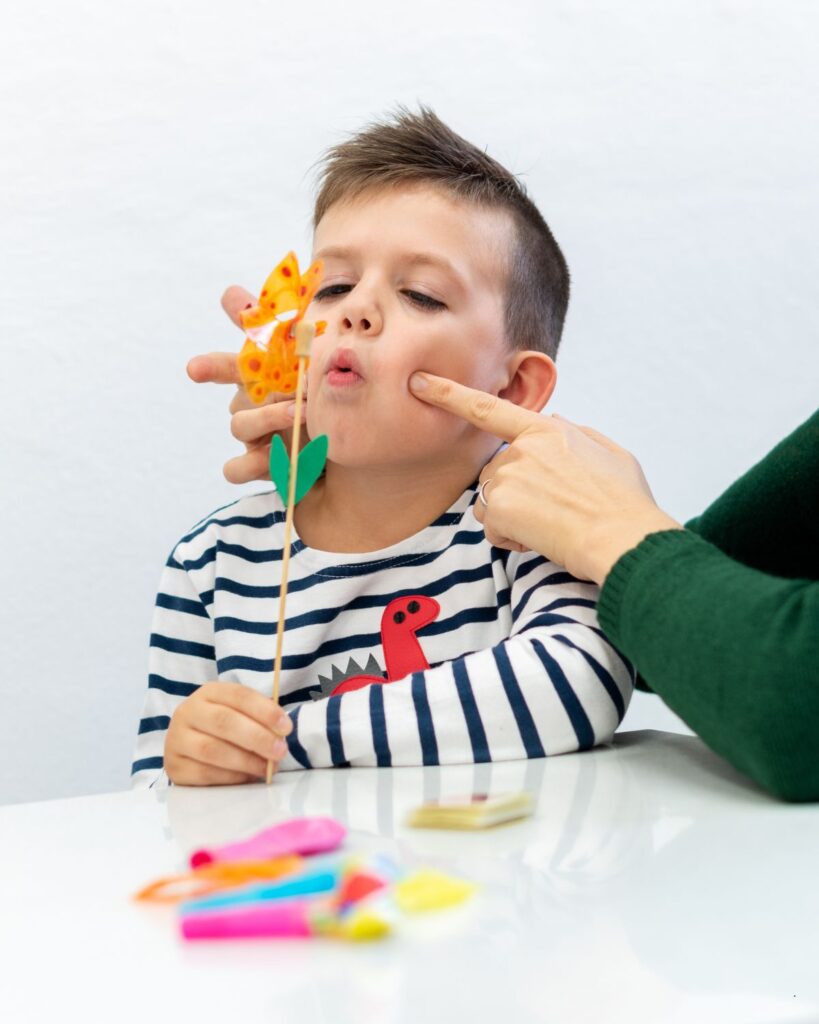
Therapy begins at the sound level, helping the child learn to produce the target sound correctly in isolation. From there, we move progressively through syllables, words, phrases, sentences, and finally natural conversation. Each step is consolidated before moving on.
Sessions are engaging and varied. We use games, activities, and materials that keep children motivated, because a child who is enjoying the session will practice more willingly and retain more effectively. For school-age children, we also tie work to sounds that appear frequently in their reading and writing, which supports literacy alongside speech.
Home practice is an important part of articulation therapy. The exercises we assign are short and specific, usually five to ten minutes a day, and we explain exactly what to do so parents feel confident carrying them out. Consistent daily practice between sessions significantly accelerates progress.
What Progress Looks Like
Articulation therapy tends to produce visible, measurable progress. Parents often notice improvements within a few weeks of consistent sessions and home practice. Full correction of a sound typically takes longer, depending on how established the error pattern is and how regularly practice happens.
Most children with a single sound error or a small cluster of errors achieve correct production within a defined course of therapy. Children with more widespread articulation difficulties may need a longer program, but progress is still clear and trackable along the way.
We celebrate progress at every stage, not just when a sound is fully correct. Moving from no correct production to consistent production in words is a significant milestone, and children respond to having that recognized.
Why Choose Next Level Speech and Physiotherapy Center, Dubai
Our DHA-licensed therapists are experienced in articulation assessment and therapy across a wide age range, from preschool children to older school-age kids who have been managing errors for years. We use evidence-based methods and keep up with current best practice in motor speech intervention.
Our clinic in Al Fattan Marina Business Hub, JBR is accessible for families across Dubai Marina, JLT, Palm Jumeirah, Bluewaters, and The Greens. Sessions are available across flexible time slots to fit around school schedules and after-school commitments.
We also recognize that many children in Dubai come from multilingual households, and articulation therapy in a multilingual context requires an understanding of how sounds differ across languages. Our team brings that awareness to every assessment.
Book an Articulation Assessment in Dubai
If your child’s speech sounds have been a concern for a while, an assessment is the clearest way to know whether intervention is needed and what it would involve. There is no benefit to waiting once errors have persisted past the typical developmental window.
Learn more about our services for children on our pediatric speech therapy page. To book an assessment or ask a question, visit our contact page or message us directly on WhatsApp. We are glad to help.
Frequently Asked Questions
How do I know if my child’s speech errors are normal for their age? Different sounds develop at different ages, and what is normal at three is not normal at six. A speech therapist can tell you precisely which sounds are within the expected range for your child’s age and which are not. If you are unsure, an assessment is the most reliable way to find out rather than relying on general milestone charts.
My child’s errors have been there for years. Is it too late to fix them? It is rarely too late. Older children and even adults can correct articulation errors with focused therapy. That said, the longer an error pattern has been established, the more practice it typically takes to change it. If your child has had an error for several years, it is still absolutely worth addressing, and sooner is better than later.
Does an articulation disorder affect reading and writing? It can. Speech sounds and literacy are closely connected, and children who have difficulty producing certain sounds may also struggle with the phonological awareness skills that underpin reading and spelling. This is something we look at during assessment and address in therapy where relevant.
How often will my child need to attend sessions? For most children with articulation disorders, once a week is the standard starting point. Frequency may increase for more complex presentations or decrease as a child progresses toward the maintenance stage. We discuss this after assessment and review it regularly.
What if my child is embarrassed about their speech? This is very common, especially in school-age children who are becoming more aware of how they sound compared to peers. We handle this with care. Therapy is a private, supportive space, and we work to build confidence alongside speech skills. Many children find that simply having someone working on it with them reduces the anxiety significantly.
Will my child need speech therapy for their whole childhood? Most children with articulation disorders do not need long-term therapy. A defined course of treatment, with consistent attendance and home practice, is usually enough to achieve correct sound production. We review progress regularly and will tell you honestly when we think a child is ready to be discharged.